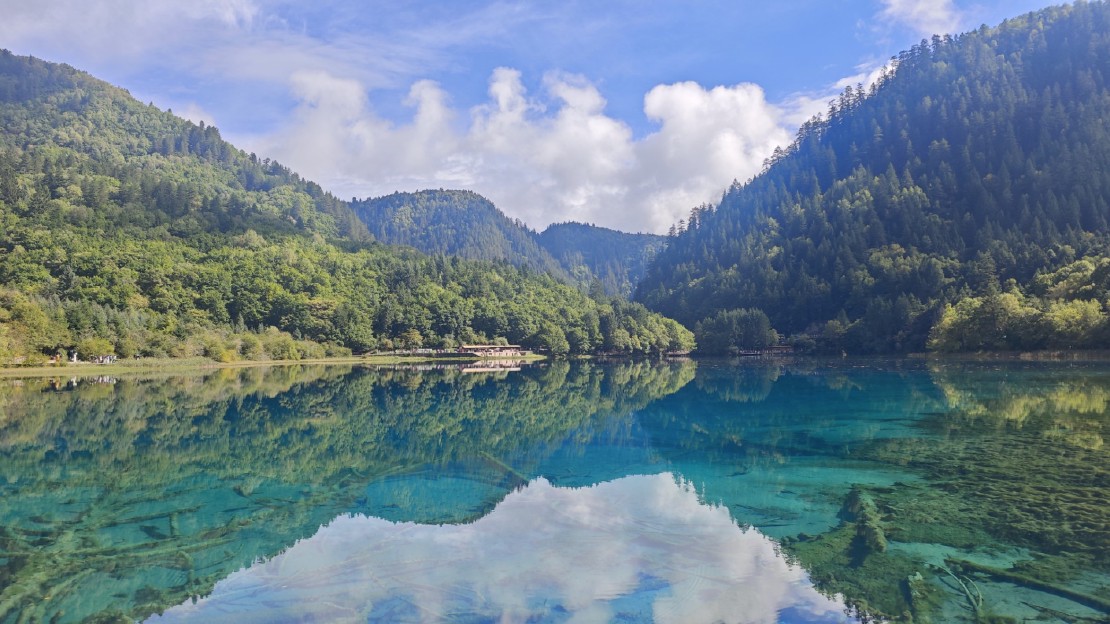
This was my fifth time in China, my third real trip (If I don’t count layovers in Shanghai and Xiamen), at first I was supposed to go to Xinjiang But a change of plan made me go to the best part of China instead. No regrets here. This is a part I thoroughly researched and that was checked by my Chinese friends. This is not 100% the trip I did, but 90% what I did. (Of course, no trip is perfect the first time, so I perfected it here)
Some links below are affiliate links: I may earn a commission if you book through them, at no extra cost to you.
For meals along the way, see the Central China food guide. For the apps and practical setup, start with Tips on how to travel China.
Why this part of China?
The variety. Shaanxi gives this route its historical weight: Xi’an, the Terracotta Army, the old walls and a food culture built around wheat, lamb and noodles.
Then the train crosses the Qinling Mountains into Sichuan, where Chengdu’s teahouses sit within reach of Buddhist mountains and the Tibetan landscapes around Jiuzhaigou, where you will be awed by the fairy pools (Huanglong / “Yellow dragon”) and the incredible colors of the Park (see the cover picture!). On the other side of Sichuan, Chongqing adds the huge city: towers, bridges, rivers and neighbourhoods spread over hills, with a mix of old and new. The 8D cyberpunk city might be exaggerated online and overrated, but it packs a punch.
Hunan changes the scenery again. Fenghuang follows the river, with its stilt houses; Furong sits above a waterfall and its stone building contrasts wildly with other towns, and Zhangjiajie’s pillars rise out of the jungle (The city is nice as well), the architecture changes, and the mix of nature continues impressing visitors.
And below Hunan, Tongren in Guizhou is the base for Fanjingshan and is an underrated place in the region, overshadowed by Guilin.
Itinerary done quick
Central China
| Day | Destination | Notes |
|---|---|---|
| Days 1–3 | Xi’an | Terracotta Army, city walls and Great Mosque |
| Day 4 | Chengdu | Wenshu Monastery, People’s Park and Kuanzhai |
| Day 5 | Leshan | Giant Buddha, Lingyun Temple and Wuyou Temple |
| Day 6 | Emei | Golden Summit, Huazang Temple and mountain views |
| Days 7–9 | Jiuzhaigou | Huanglong pools, Jiuzhaigou park, Minjiangyuan and Tibetan villages |
| Days 10–11 | Chongqing | Hongyadong, Liziba and Ciqikou |
| Day 12 | Wulong | Three Natural Bridges, Longshuixia Gorge and Fairy Mountain |
| Days 13–14 | Tongren | Zhongnanmen Ancient City and Fanjingshan |
| Day 15 | Fenghuang | Tuo River, stilt houses and old town |
| Day 16 | Furong | Tuwang palace and waterfall |
| Day 17 | Tianmen Mountain | Heaven’s Gate and cliff paths |
| Days 18–20 | Wulingyuan | Zhangjiajie and Huanglong Cave |
Days 1–3: Xi’an
Day 1 - The inner city, including the Muslim quarter
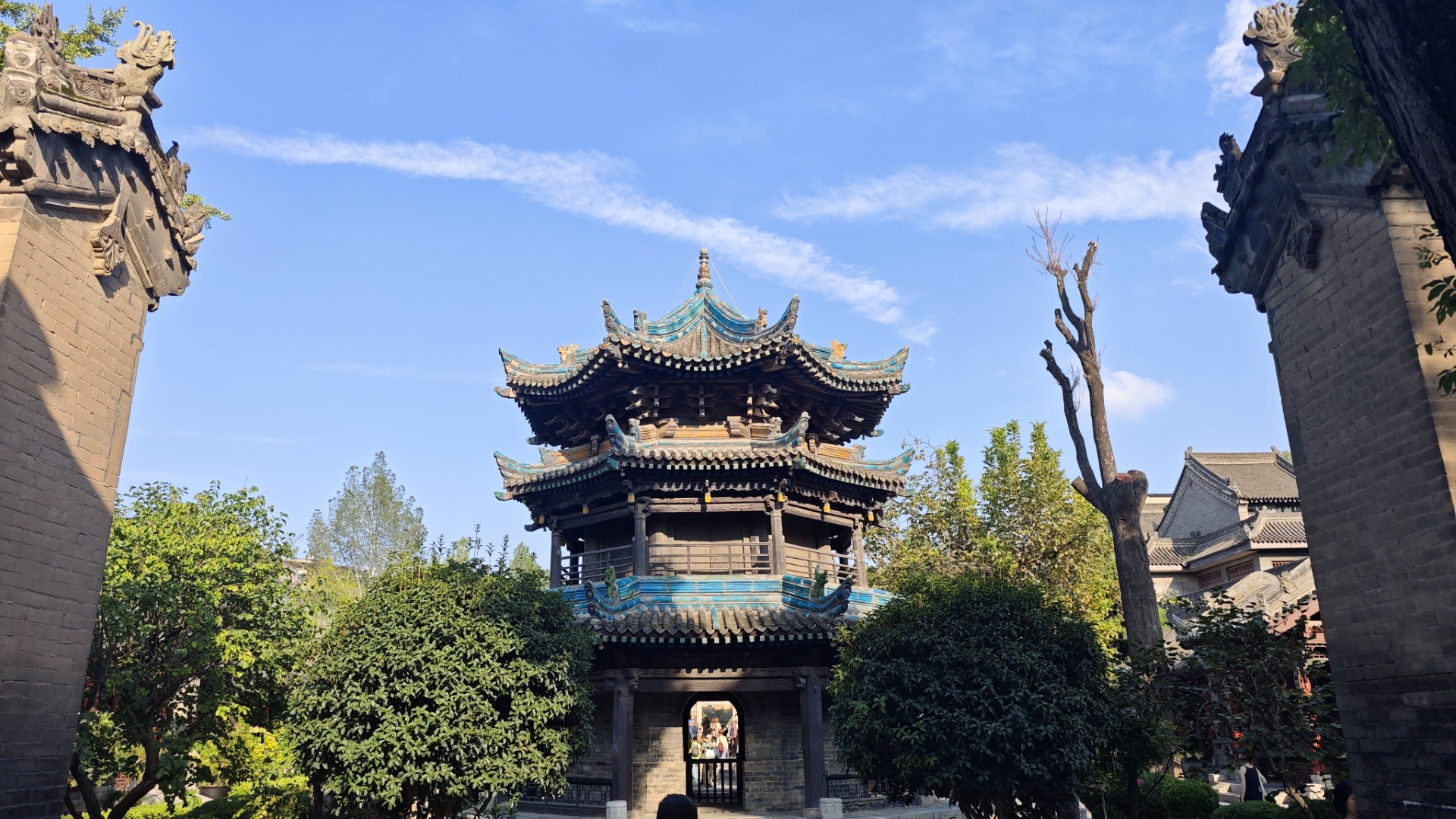 ^The courtyards of Xi’an’s Great Mosque
Alright, so I arrived at noon on my day 1, if you arrive in the evening, please consider that as day 0. Xi’an requires some time!
Stay inside or near the walls (inside is better), around Zhonglou/Bell Tower or Yongningmen, for evening walks and metro access.
From Xi’an Xianyang Airport, take the airport metro connection straight into the city, it’s fast and efficient (And very cheap). Allow 1–1:30 after leaving the terminal, enjoy the views of the city developing. Also, see how cities are planned, here the subway is planned long before the city, so you have stops to random places in the country side.
The first stop I recommend is the city center with the Drum tower, a big roundabout that lights up at night (So you have to visit twice), it’s one of the city’s main landmark. From there, just go west, see the bell tower then even more west to head to the Muslim Quarter, with noodle shops, grilled meat and sweet stalls it’s a nice place to explore and get food, but it can get crowded. The Great Mosque has courtyards and Chinese-style pavilions within the neighbourhood; The entrance is free for Muslims, alhamdulillah.
Then head even more west towards the closest city wall. Yup, we going up. Xi’an City walls are beautiful, the gates even more so. You can rent a bike on it to go around, I definitely recommend doing that. Once up, go to the north west corner to see the beautiful Tibetan temple. Then you continue around the wall as much as you can. Near the northern gate, you have nice viewpoints of the city, near the eastern gate, there is a pretty temple/guild thing. All around the walls are some expo/museums, not worth much of a stop.
At night, because sun set rather early, you can see the same areas near the center this time beautifully illuminated.
Do the first day this way and you get a rather chill arrival day. You could technically rush it after a day arrival, but any thing you didn’t do can be moved on day 2 or 3 worry-free, Xi’an is not that big.
Day 2 - Terracotta Army
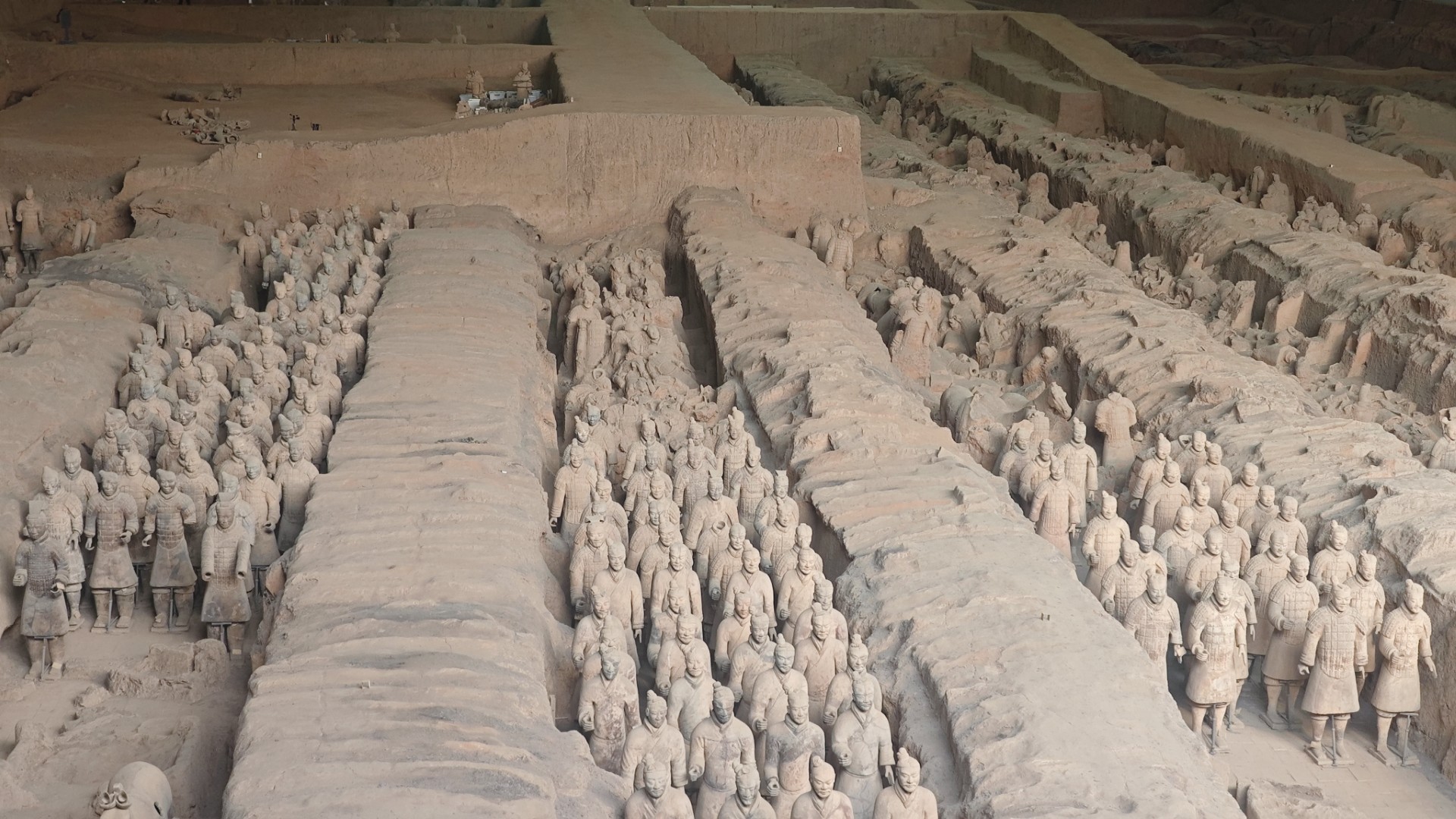 ^The Terracotta Army
What’s the main point of interest of Xi’an ? The Terracotta Army, out in Lintong. Not to be mixed up with the delicious Panna cotta army.
Pit 1 contains the largest formation of infantry and horses. Pit 2 brings together different military units, including archers and cavalry, while Pit 3 is interpreted as a command post. Allow 3 or 4 hours for the exhibition halls and pits, plus the journey. It can also be done as a tour, which I recommend, it’s easier.
For public transport, take the metro to Huaqingchi on Line 9, then the connecting local bus to the museum. Allow roughly 1:30–2 hours each way from central Xi’an and 15–20 RMB (1,90–2,50€) each way. A direct tourist coach is another option, listed around 30 RMB (3,75€) each way.
For a guide, this Terracotta Army group tour — affiliate link is the tour I did. With a really nice lunch too.
I really like the Terracotta army despite the crowds, it was just like I imagined it to be, until the exit, where it’s some kind of Disneyland full of tourist shops. Meh.
I returned in town around 3:30, even if you do it by yourself, you will probably be back before 4. This mean time for an evening activity.
I recommend going to the Wild Goose Pagoda and then Tang Paradise. They are next to each others and are iconic. Big day, great activities.
Tang Paradise is supposed to have a lot of performances, when I went, it was dead quiet. I was a bit disappointed, but I liked the night views. Of course everything inside is more expensive and, IIRC, some performances are additional fees. The area around it is actually quite nice (and lively) and worth the trip.
Day 3 - Outside the walls
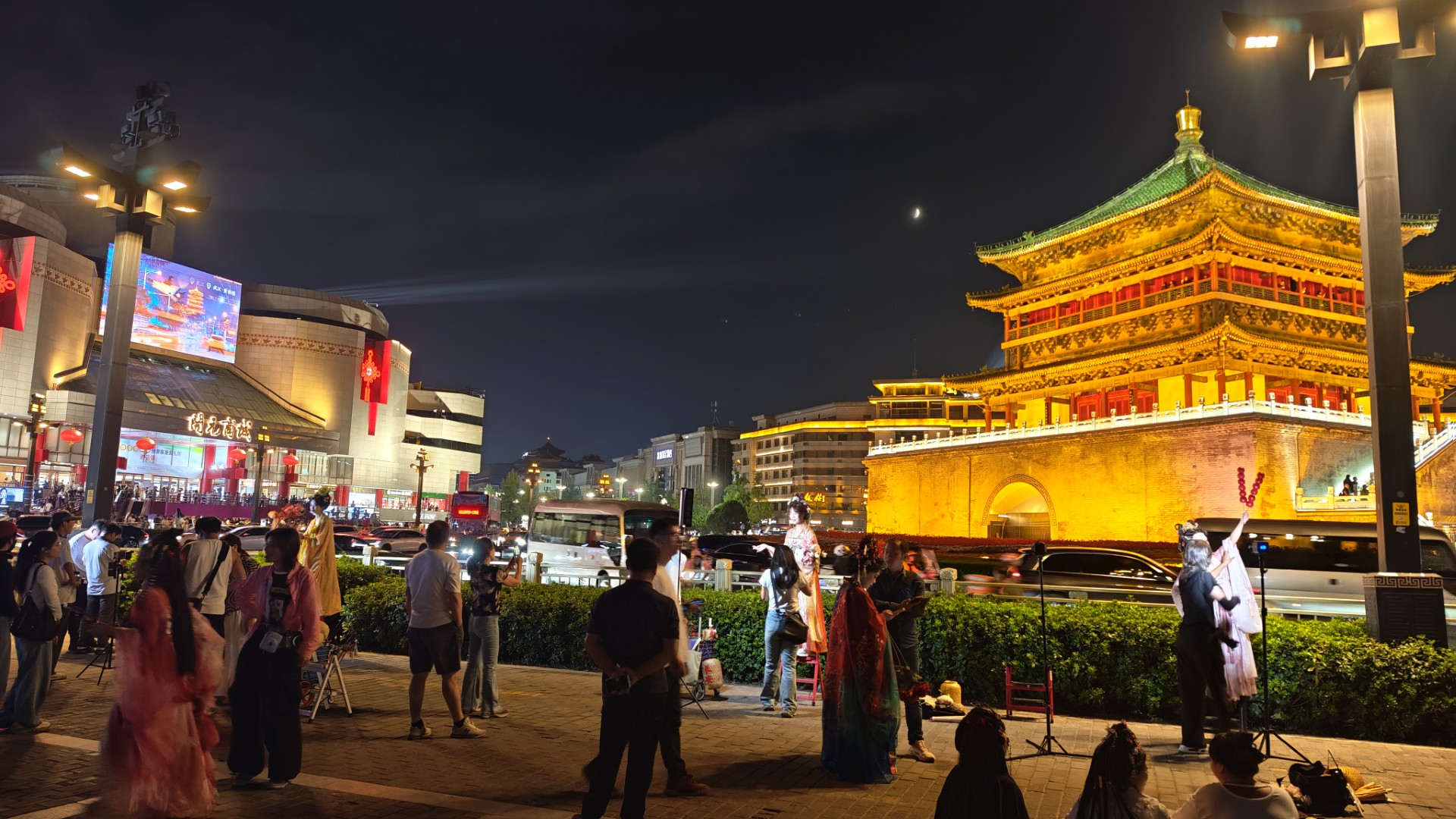 ^Xi’an’s Bell Tower at night
Spend day 3 outside the city walls. Essentially a park day. Nature within the city and some pagodas. It’s nice to see another side of a city.
Start northwest at Hanchenghu / Hancheng Lake, for a walk along the water and the Han-themed park. Then head east to Daming Palace National Heritage Park, north of the city walls. Allow roughly 1 and a half hour at the lake and 2 hours for the palace park.
DiDi are the best way to quickly go to Daming, but you can also take the subway back, desptie it being quite long due to how uncomfortable that part is (Rather long way to the the subway, then Loop line into another one…).
Daming Palace was the Tang emperors’ royal palace. Today, the visit centres on the archaeological site: Danfeng Gate, the foundations of Hanyuan Hall, the palace museum and Taiye Pond. The grounds are huge, with open lawns between the remains. The museum is a nice quick visit. Honest review: It’s a bit expensive for what it is. I would rather have just seen the Daming gate, the park where people fly kites, the view from far and then to the next destination right away.
For the afternoon, continue northeast to Xi’an Expo Park, the former horticultural exhibition grounds. Walk around Jinxiu Lake, the themed gardens and Chang’an Tower. Budget another 2 hours for a walk. I liked how empty and quiet it was. Almost eerie, totally different from the inner parts of Xi’an.
For more, add Small Wild Goose Pagoda and Xi’an Museum, which share a site south of the walls. (This is a separate pagoda from the Giant Wild Goose Pagoda, but it looks similar). I didn’t go because I didn’t know about the place, despite largely having the time for it…
Day 4: Chengdu
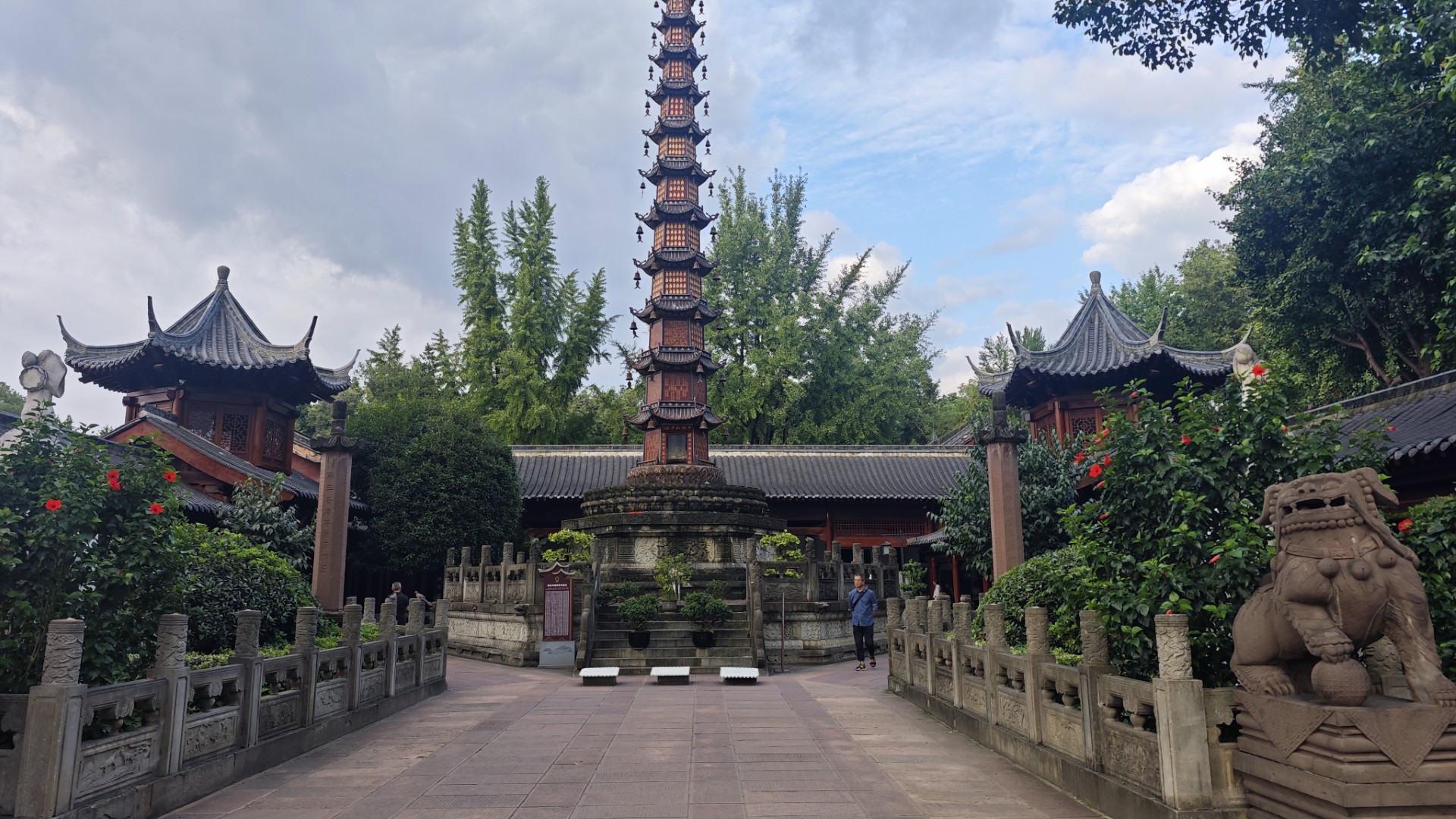 ^The Wenshu monastery, it’s almost empty
Book Xi’an North / Xi’anbei → Chengdu East / Chengdudong. Trains take roughly 3:30. Budget 220 RMB (27€) in second class. Try departing early, or leaving late the previous day.
After dropping your luggage, start at Wenshu Monastery / Wenshu Yuan, then People’s Park, followed Kuanzhai / Wide and Narrow Alleys. Entry to all three is free.
Wenshu has temple courtyards, gardens and teahouses, it’s really quiet in the evening (More centered around tea and calligraphy), I loved it. It’s calm, colorful, surprisingly tidy… Not far, you can find the main square of Chengdu, with all the high rise buildings and Mao Zedong’s statue, worth a quick stop, essentialy to catch line 1.
At People’s Park, the main stop is a cup of tea at Heming Teahouse, with outdoor seating around the park. Kuanzhai combines restored courtyard buildings with shops and restaurants (But it’s overly touristy).
You can also see the Wuhou shrine, if you’re not tired of temples. But honestly, just walking around the lively districts of Chengdu is part of the city experience.
I’m not the biggest fan of Chengdu as a tourist, feels like a city where you want to live in, but not for visiting, weird isn’t it?
Day 5: Leshan side trip
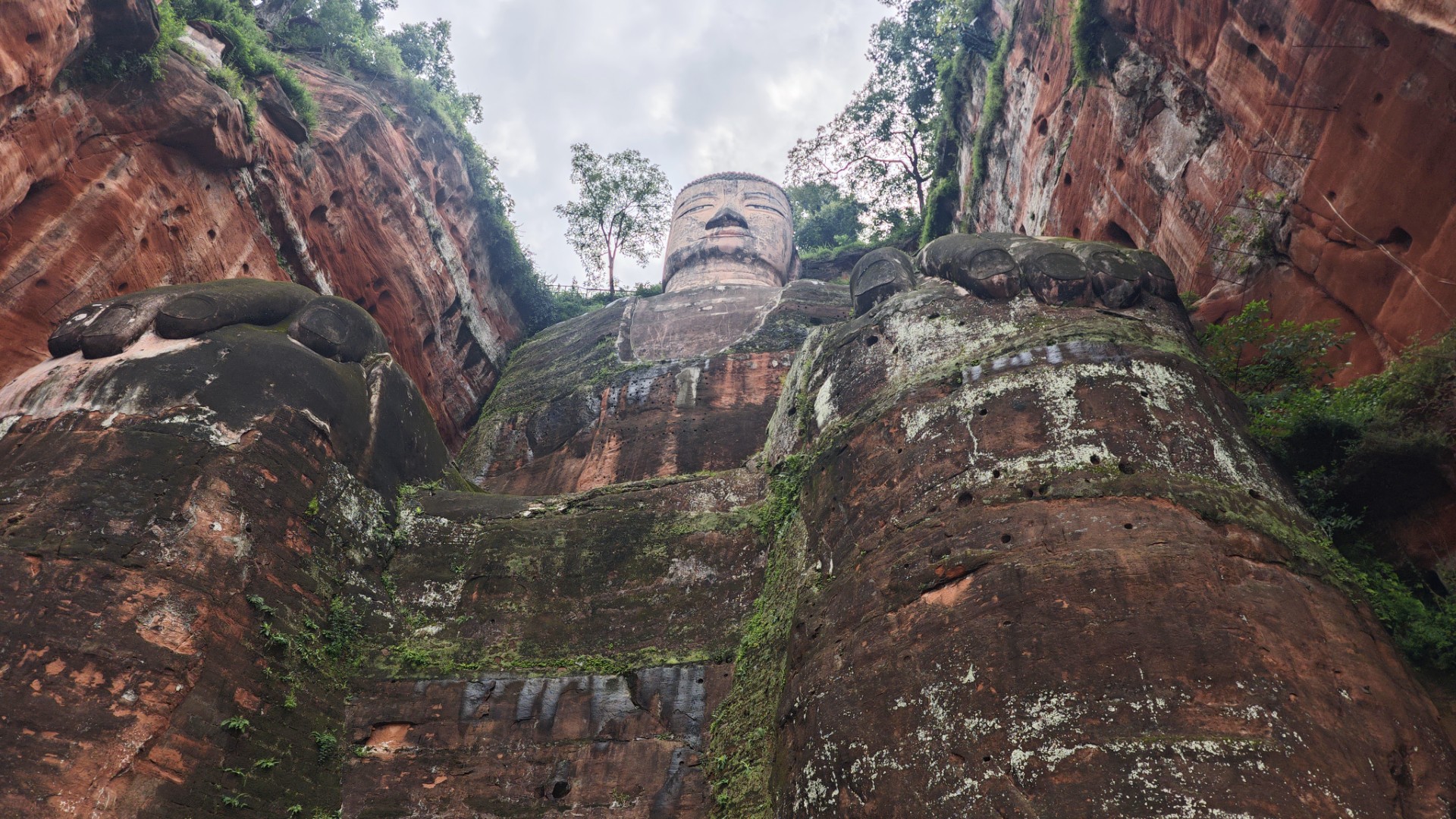 ^The Giant Buddha of Leshan, carved into the cliff
Getting to the Buddha
Take a morning train from Chengdu East to Leshan, usually around 45 minutes–1:15. Budget 50–80 RMB (6,25–10€) in second class. Allow another 45–60 minutes by public bus, with 5–10 RMB (0,60–1,25€) set aside for local rides. Bus 3 connects Leshan station with Leshan Giant Buddha / 乐山大佛.
On foot, you see the head, temples and cliff paths; The boat gives a frontal view from the river, but depends on river conditions. Published prices are 80 RMB (10€) for land admission and 70 RMB (8,75€) for the boat, separately.
The sleeping buddha is an additional fee, but it’s dumb, because you see it from the road, it’s gigantic. Otherwise, if you head inside, you can see some recent buddhas and have another path to the Giant Buddha of Leshan.
Honestly, the size of that thing is impressive; And Leshan is not just the Buddha, it’s the whole place, the temples, pagodas, carved rocks, the cliffs, the river… Even the Suji old town nearby is worth a stop. I recommend a tour to have a guaranteed easy stop in Suji, it’s authentic in the backstreets.
This Leshan private road tour — affiliate link lists Suji Old Town as an optional stop at extra cost. Arrange that stop with the operator before booking.
If going by road/tour, you can/will stop in Suji on the way back. For an hour or so, it’s short, two hours are better. This is the hometown of the offal beef soup, and there’s even the museum!
For an arranged version, compare the Leshan rail day trip — affiliate link with the Leshan and Emei two-day tour — affiliate link. The rail day trip returns to Chengdu; the two-day tour includes Emei. Mountain buses and cable cars may cost extra.
Day 6: Emei
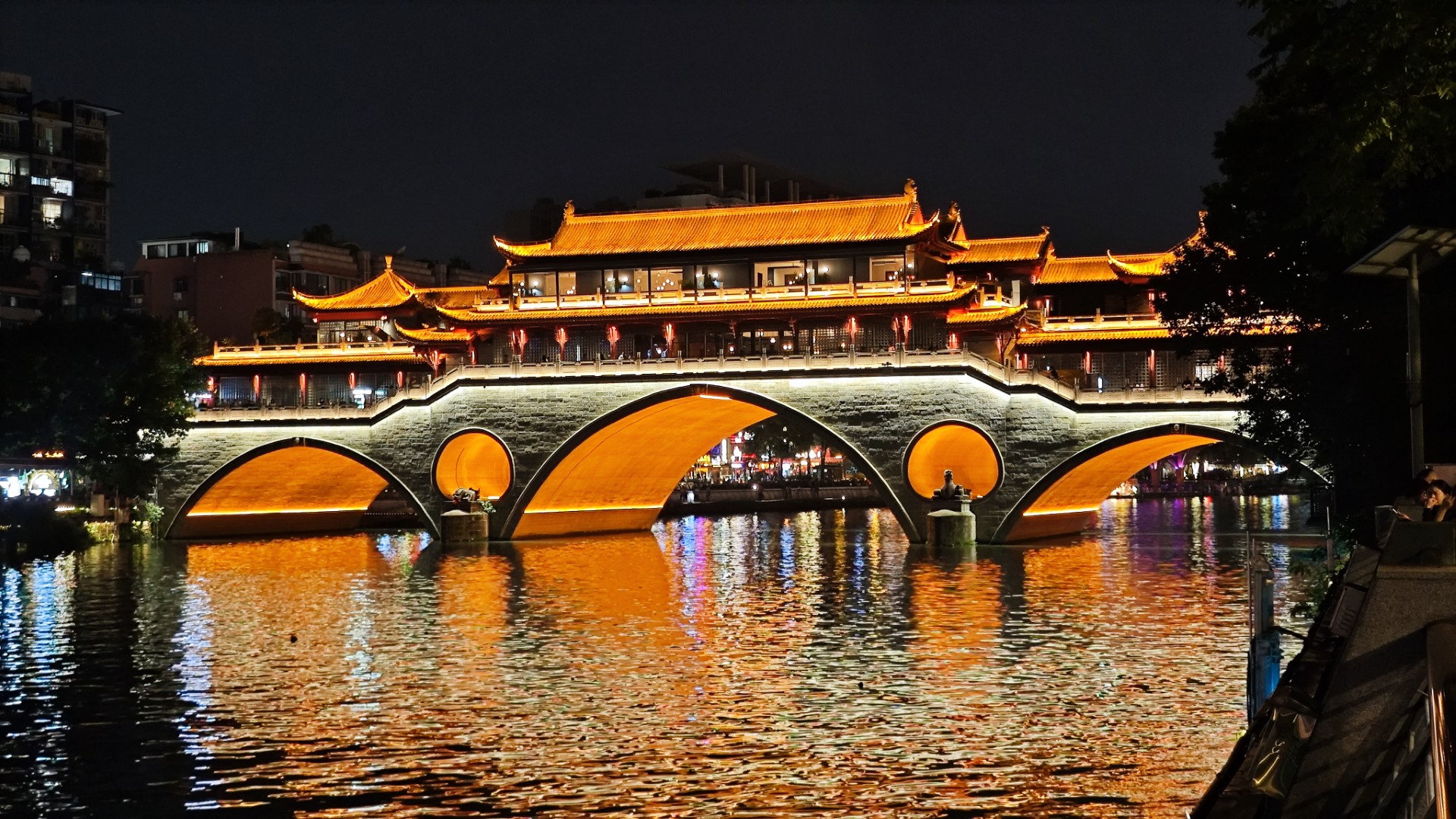 ^Anshun Bridge lit up at night
Other travellers and my Chinese friends recommended Emei Shan. I couldn’t do it because I had slightly less than three weeks. This is the extra day I’d add after Leshan. So, this is not very “My trip” but I searched all the info for you, dear reader!
Spend the day on Emei Shan, with the Golden Summit as the main stop. At about 3 077 m, the summit brings together the enormous golden Samantabhadra statue, Huazang Temple and viewpoints over the surrounding mountains. Walk around the statue, visit the temple halls, then follow the viewing terraces along the cliffs. On a clear day, the ridges stretch into the distance; cloud can sit below the summit or swallow the views entirely. (yay, another foggy place! Wait I spoiled you the rest of the article!!)
Start early from the Baoguo/Huangwan area. The mountain bus climbs through the forest to Leidongping, taking roughly 2 hours. From there, walk uphill for 20–40 minutes to Jieyin Hall, then take the cable car to the summit. Allow roughly 1–2 hours at the top as a planning estimate, before returning to Leidongping for lunch and the bus down.
For forest trails and smaller temples instead, choose Wannian Temple and Qingyin Pavilion as an alternative to the summit. Combining both routes needs another day.
Stay near the mountain entrance after Leshan: the Leshan → Emeishan train takes roughly 15–25 minutes, followed by a local bus to Baoguo/Huangwan. After the mountain visit, return to Chengdu by train, allowing roughly 1–2 hours and an estimated 35–80 RMB (4,40–10€) for the rail leg.
October 2026 summit costs: 160 RMB (20€) admission, 90 RMB (11,25€) for the return mountain bus and 120 RMB (15€) for the return Golden Summit cable car: 370 RMB (46,25€) in total, before meals and trains. Official tariffs. Renovation work is limiting summit admission and transport capacity; reserve the summit entry, bus and cable car ahead. Official access notice.
Late afternoon at the Panda Base
Add the Chengdu Research Base of Giant Panda Breeding if you can reach its entrance around 15:30–16:00. Apparently some Emei tours return a bit too late, some do include the Panda Base afterwards, but they start early. For an early start, you can stay around Leshan. From March to October, last admission is 17:00 and clearance begins at 18:00.
Walk between the panda enclosures and bamboo-lined paths; the optional sightseeing bus covers the longer stretches. Admission is 55 RMB (6,90€), plus 30 RMB (3,75€) for that bus. Reserve an afternoon ticket with your passport. Official tickets, sightseeing bus.
Days 7–9: Jiuzhaigou
Day 7: Huanglong and on to Jiuzhaigou
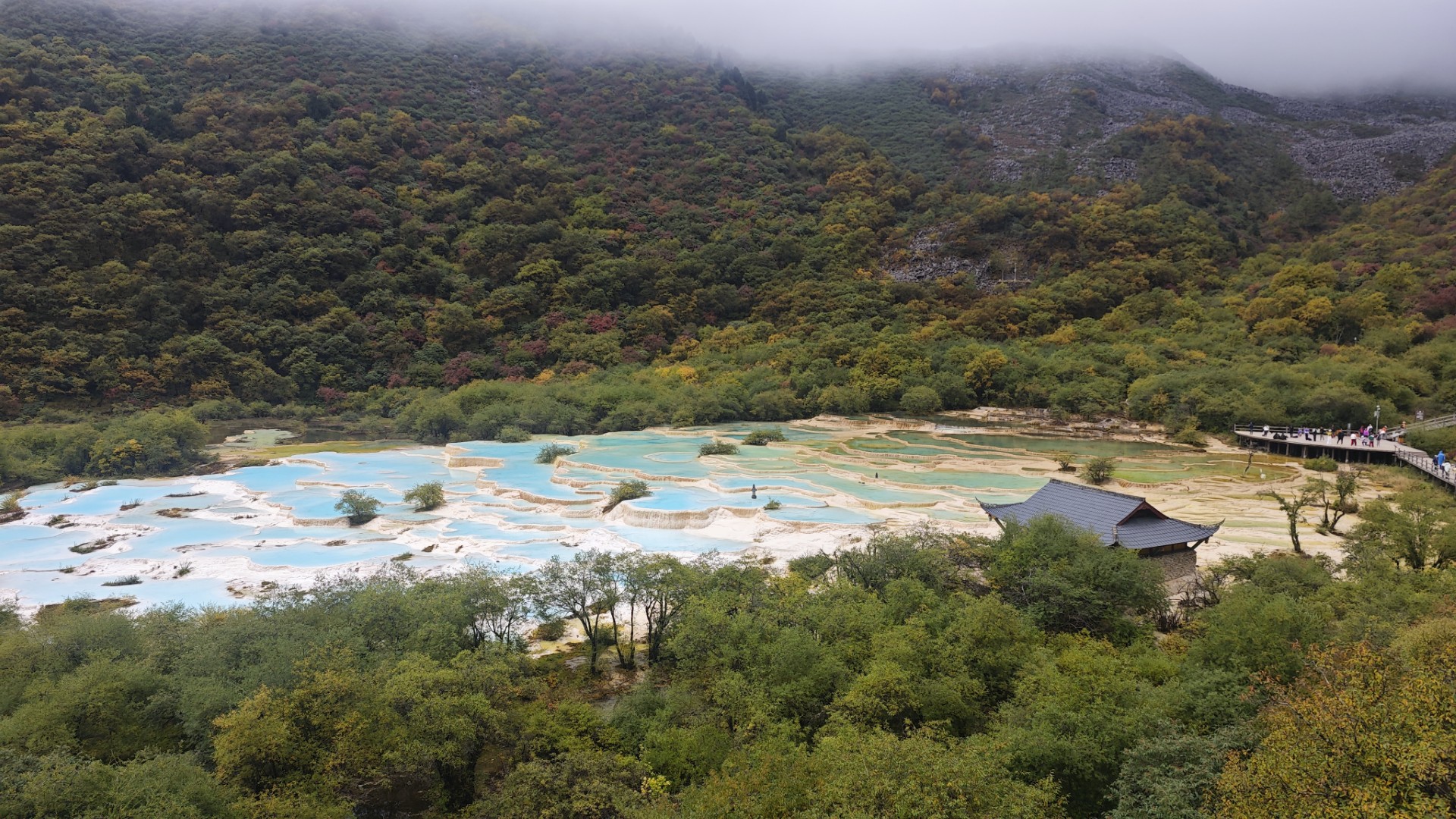 ^The turquoise pools of Huanglong
You can also book this two-day Huanglong and Jiuzhaigou tour — affiliate link, with a driver, park admission, the Jiuzhaigou bus and the Huanglong uphill cable car. The standard tour returns to Chengdu after the park visit on day two.
I did a three-day tour for around 120€ booked locally in Chengdu. The guide spoke only Chinese but was really fun. The hotel was really nice too.
To reach Jiuzhaigou from Chengdu via Huanglong, take an early train from Chengdu East to Huanglongjiuzhai, even if you have a guided tour. If you have no guided tour, then you will need to catch an additional shuttle bus to Huanglong. It’s around 2 hours on the train, followed by 35–50 minutes on the bus. Budget roughly 130–180 RMB (16,25–22,50€) for the train and 28 RMB (3,50€) for the bus. Station connections.
Take the cable car up and walk towards the Five Colour Pool. This is where you get the view of turquoise pools stacked down the mountainside, with the forest behind them. Walk past Huanglong Temple, then follow the boardwalk downhill, along the smaller pools, terraces and waterfalls, to the Welcoming Pools near the entrance. The way down is easy and straightforward.
Count around 4 hours for the visit. Note: The upper pools are at about 3500m, and even with the cable car, there’s some uphill walking. My friend wasn’t well at this altitude.
Entry costs 170 RMB (21,25€), plus 80 RMB (10€) for the cable car up: 250 RMB (31,25€) together. If you take the cable car down too, add 40 RMB (5€).
Afterwards, take the tourist coach to Jiuzhaigou, roughly 2:30–3 hours away. (Or go back with your tour, you lazy ass SoB) Budget around 60–100 RMB (7,50–12,50€) for this leg.
Stay near the park entrance for the next two nights! With my tour, we had very high quality hotel rooms. Really 120€ for three days including trains, accomodation, entrance tickets and a guide. Wow! Awesome value.
Day 8: Jiuzhaigou National Park
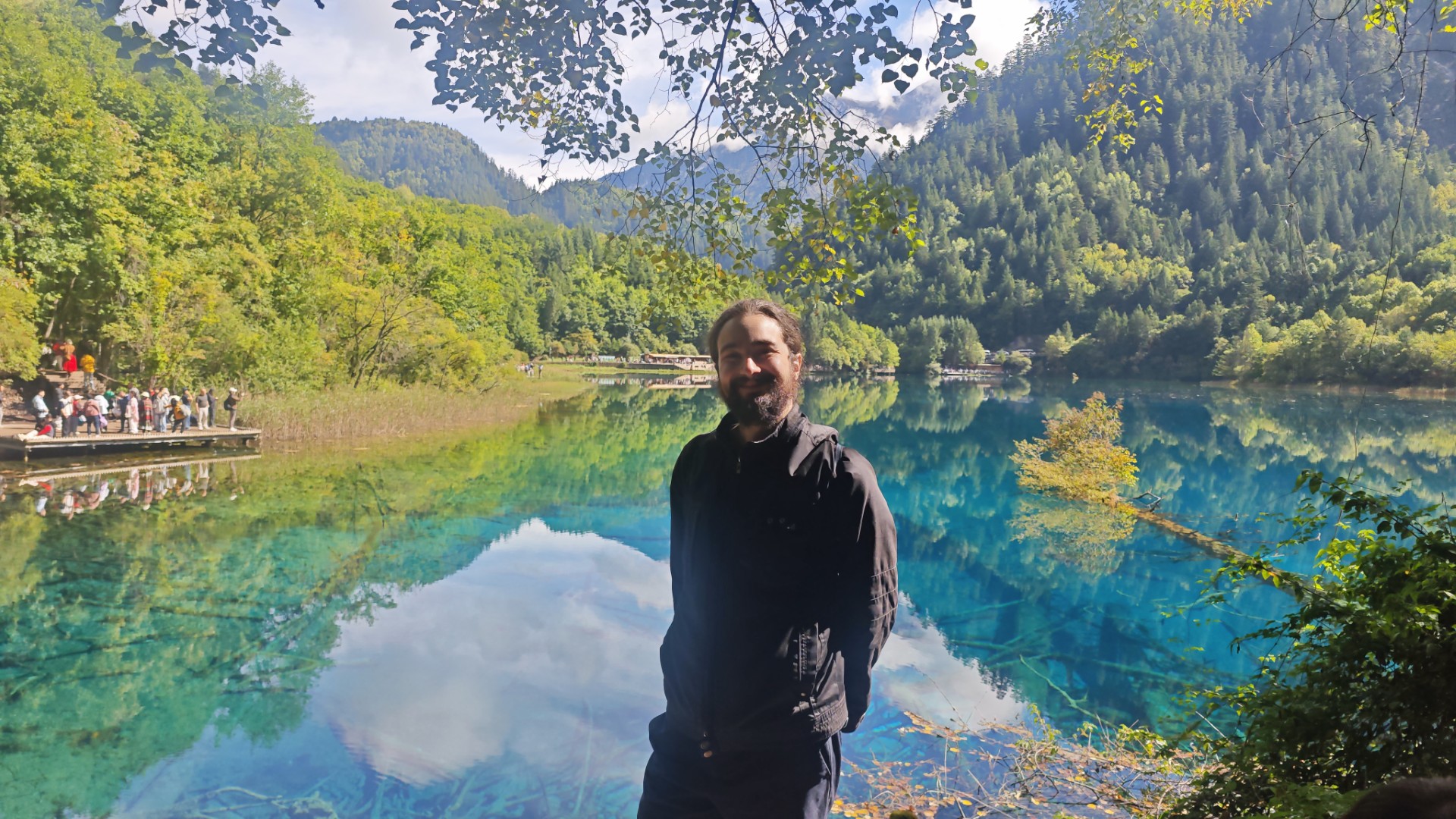 ^ Beside a clear blue lake in Jiuzhaigou, rare pic of me, unedited, as you can see I’m fugly on it
A full day for the lakes, waterfalls and the general area! There are three valleys to explore, with buses between them and boardwalks for the walks along the water.
Start with Rize Valley, Five Flower Lake and Pearl Shoal Waterfall. The water is clear enough to see the fallen trees below the surface. Walk between the lakes and the waterfall, taking the bus for the longer stretches.
Then head to Long Lake in Zechawa Valley, and walk down to the much smaller Five Colour Pond. Return to Nuorilang for lunch and the waterfall nearby. The morning bus may take you to Long Lake first; in that case, do these two valleys in the opposite order.
Keep Shuzheng Valley for the way back: Rhinoceros Lake, Shuzheng Waterfall, the lakes and the village. Walk the lakeside paths, stop in Shuzheng Village, then take the bus back to the entrance.
The park’s route guide shows the three valleys.
Entry is 190 RMB (23,75€), plus 90 RMB (11,25€) for the bus (well needed): 280 RMB (35€) for the day. From 16 November to 31 March, the total drops to 160 RMB (20€). Booking Jiuzhaigou tickets with a foreign passport is possible online through the park’s official WeChat account, 九寨沟, under 游览必看 → 门票预定. The reservation covers a dated entry and the sightseeing bus; the same passport is used at the entrance. Official tickets.
Note that you should bring lunch, food options aren’t great.
Day 9: Jiuzhaigou to Chongqing
Start the morning with a stop at Minjiangyuan, then visit the Tibetan villages in Zhongcha Valley, near Zhangzha, before leaving for Chongqing. Arrange the return transfer through your accommodation to fit your station coach. Zhongcha Valley.
Then it’s back to Huanglongjiuzhai station, around 2 hours by coach, and on to Chongqing by train via Chengdu East. Leave 60–90 minutes between trains in Chengdu.
Count roughly 6–8 hours for the journey, after the village visit.
A more boring/transit day, but sometimes they are needed. I didn’t want to spend more time in Chengdu. I was there with a friend and we had limited time together.
Day 10: Central Chongqing and the riverfront
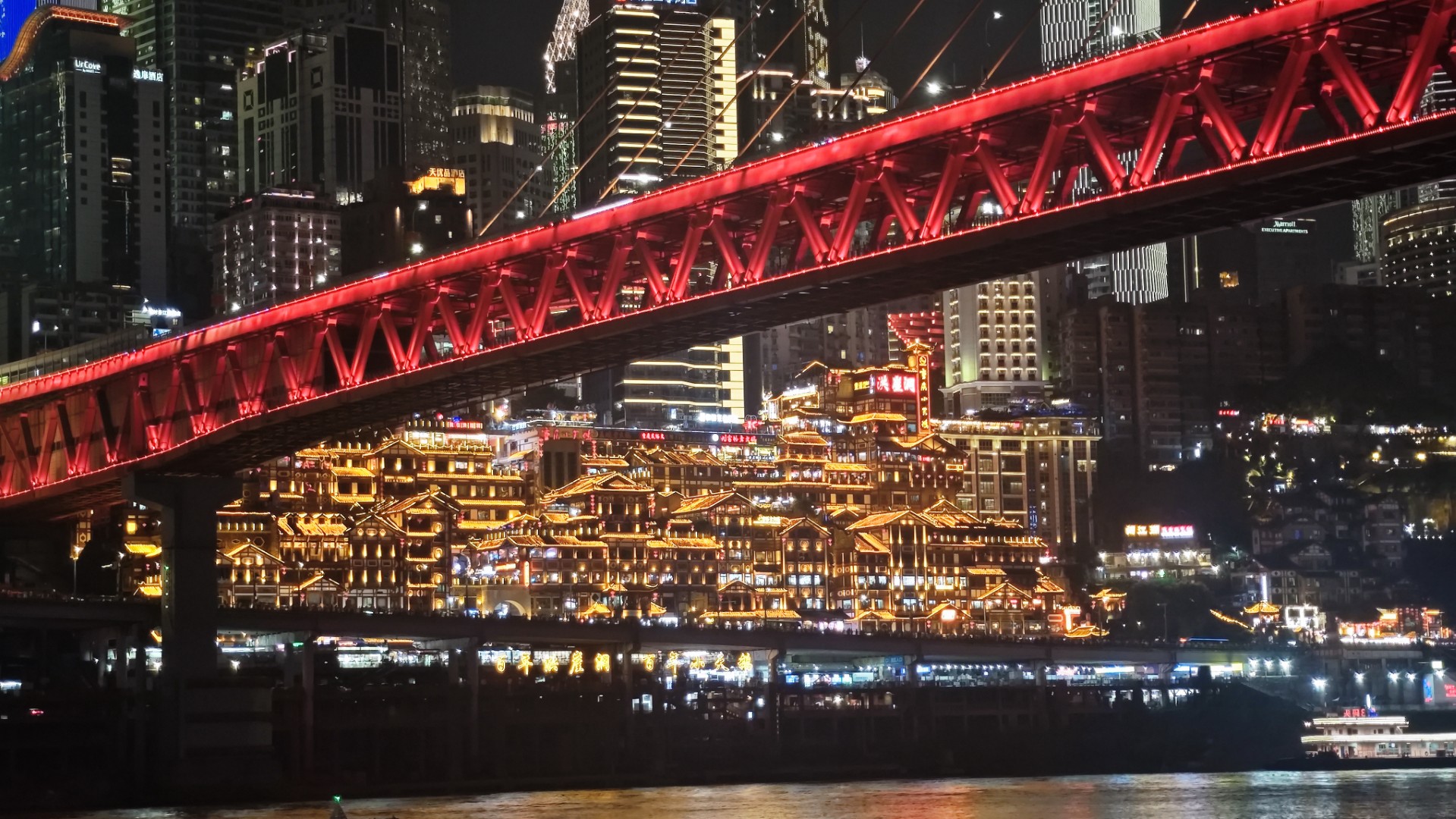 ^Hongyadong and Qiansimen Bridge at night
Alright folks, today’s walk makes a loop through the centre, out to Chaotianmen and back along the river to Hongyadong after dark.
Be prepared, for a lot of stairs, you gonna climb. Up and down. Again and again, welcome to Chongqing!
Start at Jiefangbei Pedestrian Street, around the Liberation Monument. This is the Times Square side of Chongqing: huge shopping centres, screens and towers above a busy pedestrian district. Walk around the monument and the shopping streets, with a stop at nearby Bayi food street for breakfast or snacks. Personally, I found Bayi far too loud and busy.
Note: Linjiangmen, on Line 2, is a convenient metro stop for the start.
Then walk northwest to Kuixinglou / Kuixing Building. Cross the raised walkways and look down: what feels like ground level is several floors above the streets below. There are views towards the Jialing River and the buildings stacked along the hillside. Head east along the upper streets to the Chongqing Art Museum at Guotai Arts Center, the red building made of interlocking beams near Hongyadong. Stop for the building itself and the exhibitions inside. Entry is free; it opens 9:00–17:00, with last entry at 16:30, and normally closes on Mondays.
I didn’t go inside, but this could be nice for a rainy day
Continue east towards Xiaoshizi and Luohan Temple. Its courtyards and Buddhist halls sit between the high-rises, with rock carvings along the entrance passage and a hall full of clay arhats, each with a different expression. Give it time for a proper walk through the halls. The entrance fee is cheap but the exterior parts are the best, I really liked seeing all the Taoist cosplays around.
From there, head downhill towards Huguang Guild Hall, near Dongshuimen on the Yangtze side. (There is an elevator for free, or long steps around it, the view from above is much better from what’s below) Explore the yellow-walled courtyards, carved wooden opera stages and Yuwang Palace, the temple dedicated to Yu the Great. The complex tells the story of the migrants and merchant communities who settled in Chongqing. It’s quite too expensive for what it is, but you do you.
After lunch, follow the Yangtze riverfront towards Chaotianmen and Raffles City. The towers stand at the tip of the peninsula, where the Yangtze and Jialing rivers meet. Walk out to the square and river viewpoints; You can also head all the way up, if you got the money!
The view is splendid, the Raffles City is a trip within itself, with so many colourful shops. Perfect for gifts.
Round the tip and follow the Jialing riverfront west to Hongyadong. This brings you to the lower levels of the hillside complex. Walk through its stairs, balconies and shops, then come back out for the illuminated buildings after dark. Finish on the pedestrian side of Qiansimen Bridge for the view back at Hongyadong. Cross farther towards Jiangbeizui if you want the skyline from the opposite bank.
Walking around Chongqing in the dark is something else too. Well “In the dark” not really, since everything is so bright!
I slept in a Lavande Hotel, rather cheap and of very nice quality.
Day 11: Liziba, Ciqikou and Shibati
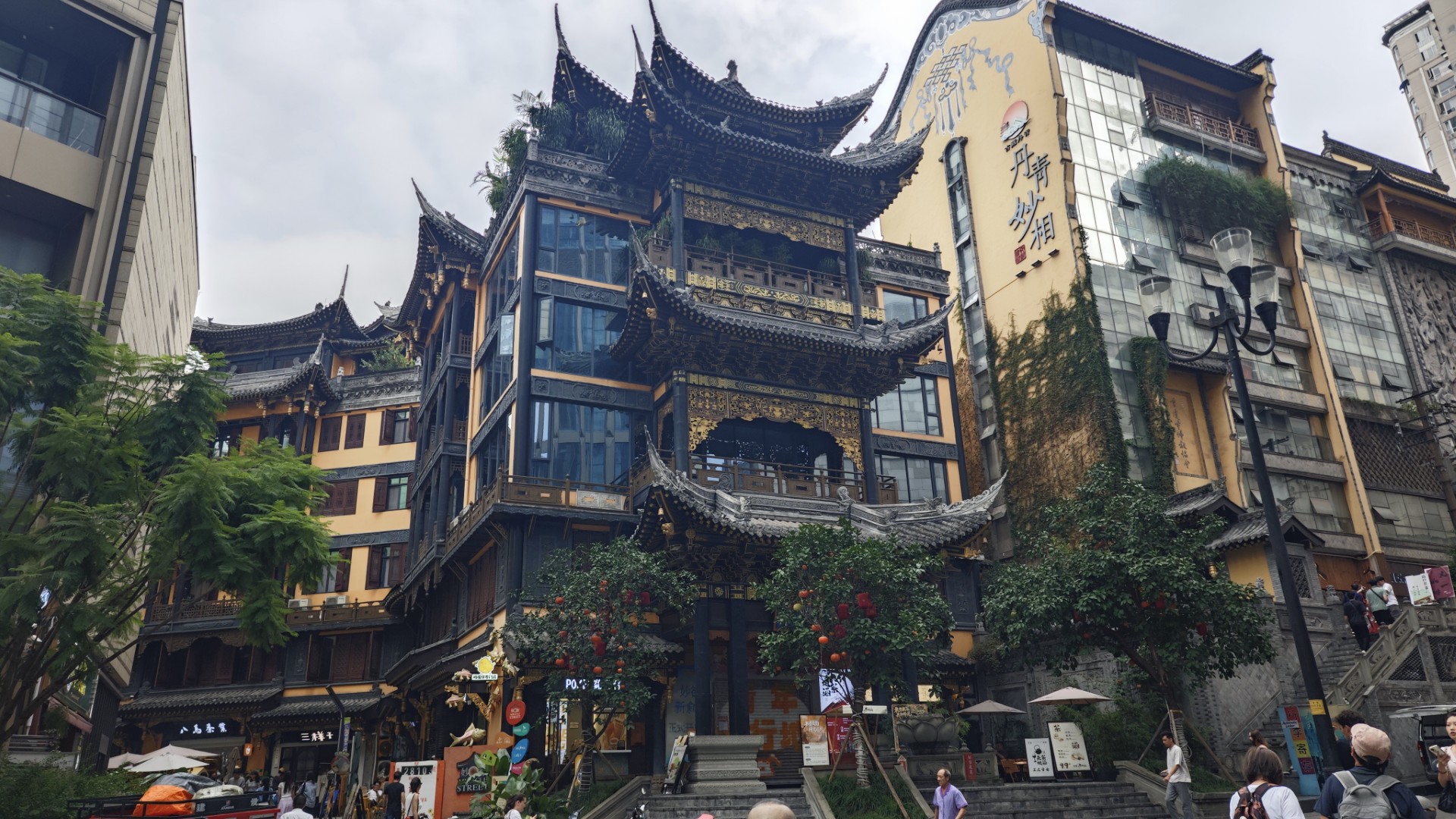 ^The Luohan Temple amidst modern buildings
Start with Shibati, then visit the People’s Auditorium, Liziba and finally Ciqikou. The first stop is near the centre; the rest follow the metro west across the city.
Walk to Shibati / Eighteen Steps from Jiaochangkou station, on Lines 1 and 2. Follow the stone steps down through the restored lanes, stopping in the smaller side streets between the shops and teahouses. The change in level is part of the visit: the stairs link the upper city to the lower neighbourhood. Loop back towards the upper entrance and Jiaochangkou when you’re done.
Take Line 2 from Jiaochangkou to Zengjiayan, then walk to People’s Square and the People’s Auditorium / Great Hall of the People. The auditorium’s green-tiled dome and red colonnades face the square, with a design inspired by Beijing’s Temple of Heaven. Walk across the square for the full view of the building. Also, you can head inside for 10 RMB, it’s a quick visit inside, to see the actual auditorium.
The Three Gorges Museum is opposite, if you want to add a museum visit, I didn’t do it, seemed boring.
Return to Zengjiayan and continue on Line 2 towards Yudong, getting off at Liziba.
Step down from the train, go down where everyone is screaming with their mouths open (yes everyone is pretending the train is going in their mouth, or their ass, which is much funnier.) and enjoy this famous station. You can also have a different view from the inside of the station, with my friend, we waited inside for some time to catch it.
Back on Line 2, continue to Daping and change to Line 1 towards Bishan. Get off at Ciqikou and walk into the old town. Allow roughly 45 minutes for this leg, including the change and walk, as a planning estimate.
Spend the afternoon in Ciqikou: the main shopping lane, the narrower streets branching off it, teahouses and the Jialing waterfront. Head towards Baolun Temple for its halls and stone steps, then work your way back through the lanes. There are plenty of places for a late lunch or an early dinner (But street vendors make you taste food, so you can just walk around and get food that way)
Take Line 1 back to Jiaochangkou for the evening in the centre. For Guanyinqiao’s shopping streets instead, change at Lianglukou to Line 3 towards Jiangbei Airport and get off at Guanyinqiao. I went to Guanyinqiao, it’s nice for people watching, but not much more, far too crowded to my liking.
Day 12: Wulong day trip
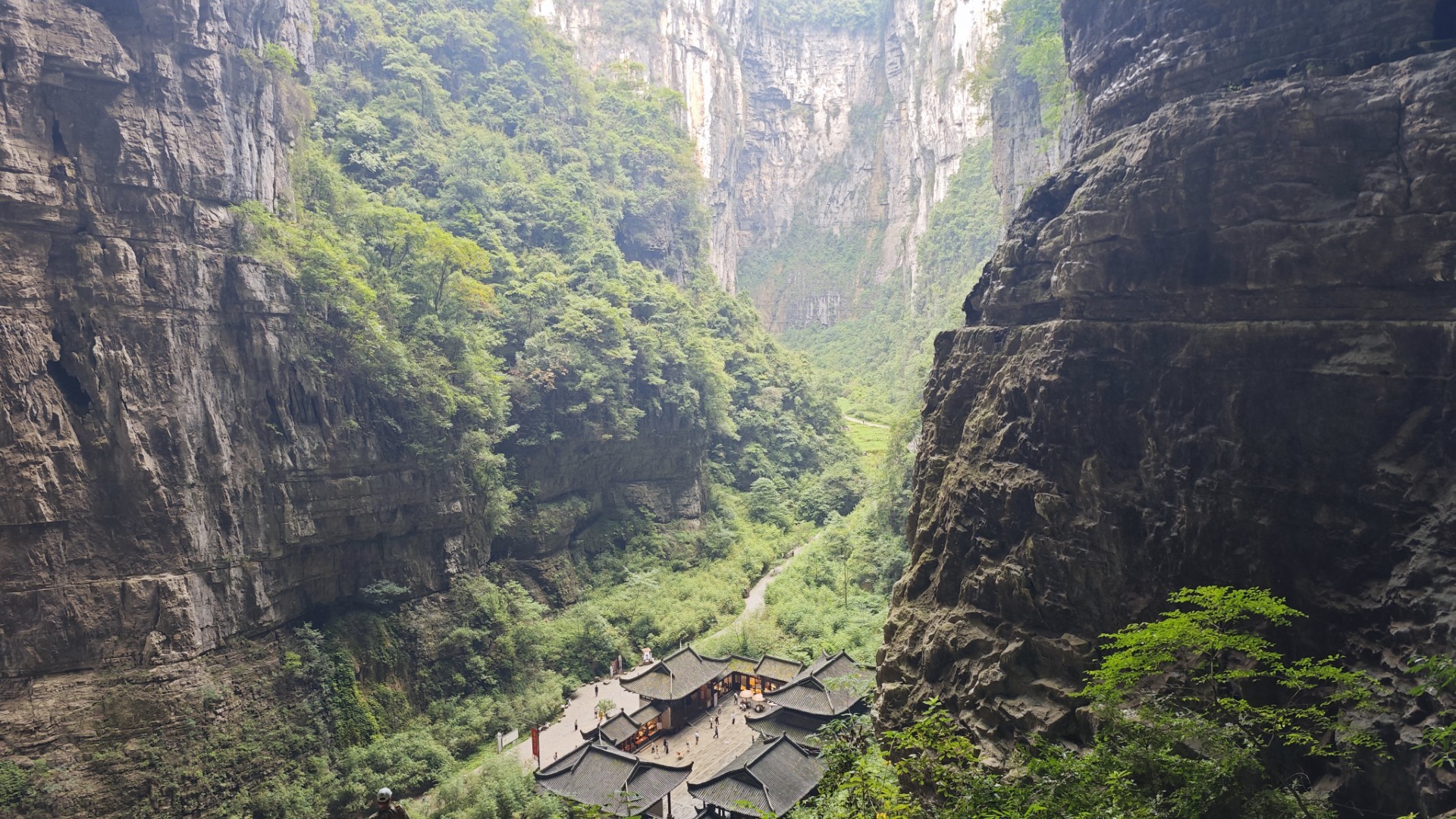 ^The Tianmen Post below the cliffs of Wulong
Visit Three Natural Bridges, Longshuixia Fissure Gorge and Fairy Mountain. Either by yourself or by tour. My tour included all three.; if going by yourself, drop the fairy mountain, it’s not worth it.
I also researched how to visit Wulong without a tour:
Search trains to Wulong South / Wulongnan as well as Wulong. Continue by the official tourist transfer towards Xiannüshan visitor centre, then use the scenic shuttles. Set aside 1–1:30 for the station-to-visitor-centre road leg and waiting. Fairy mountain is harded to access, I coulfn’t finf ways to do it.
Budget roughly 155 RMB (19,40€) for the commonly sold Three Natural Bridges access/transport bundle, 105 RMB (13,10€) for Longshuixia’s bundle, or 50 RMB (6,25€) for Fairy Mountain entry, with its internal train extra.
Honestly, tours are better, believe me, and I don’t even like tours. Personally, I booked it on Trip.com, with a chinese driver that used Google translate to communicate with me. Also note that food options tend to be bad, it’s better to bring lunch.
Set aside 400 RMB (50€) for a tour. Mine started at 05:00 and returned around 19:00, with all three main sites included. Lunch was extra. It’s expensive and difficult doing it alone, but I saw a few folks do it over two days.
The day with the tour is rather intense but it didn’t felt like waiting for others oall the time and rushing from one place to the other. We had an hour for lunch, an hour for the fairy meadows (covered in fog for me, but at least there was a nice band playing there), two hours for the Wulong site, one hour for the canyon, or something like that. The Wulong Site is not just the Tianmen Post and transformer statue everyone (like me) shows. There is also the rotating elevators, the horse riding area, the waterfalls, the numerous arches… And the canyon after is actually pretty with a nice waterfall.
Fairy Mountain has meadows and foggy forests full of lingzhi mushrooms. Iconic. it’s nice to see some grasslands, but really, not a highlight. After going down from the fairy mountain and its stupid ass train, heading to Wulong Kasite (That’s how it’s called, it’s not a mistake) to see the real attractions. It’s just as described above.
It’s a rather circular circuit, quite easy, no big ways up or down, elevators are required (included in the ticket). Then, to transit from the Wulong Karst to the Longshuixia Fissure Gorge, you can ride a paid bus or walk up the hill, it’s not long. This will get you near a large tourist store, then a parking lot where there are tour buses, cars, taxis, probably tourist shuttles as well
This Wulong and Fairy Mountain tour — affiliate link includes a vehicle and guide, with attraction tickets and meals charged separately. But the price is batshit crazy, they smoked pot before publishing that shit.
Days 13–14: Tongren and Fanjingshan
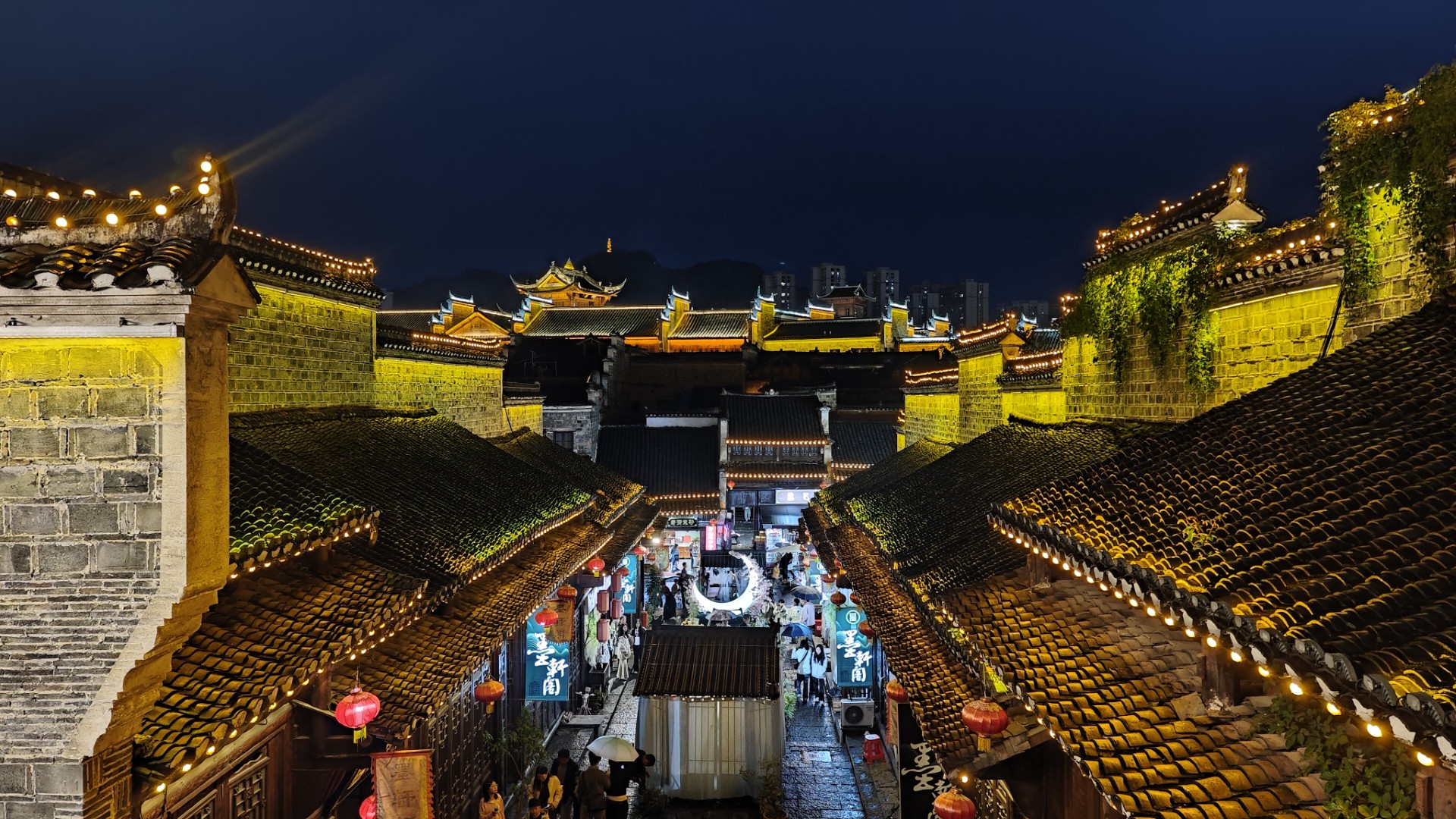 ^Zhongnanmen after dark
Chongqing to Tongren
Allow 3–5 hours by rail, potentially with a change, and 180–300 RMB (22,50–37,50€) in second class. The station for the city is Tongren / 铜仁; Tongren South / Tongrennan / 铜仁南 is farther away.
With an early arrival, head to Tongren Grand Canyon; budget an estimated 150–250 RMB (18–32€) for the whole outing Apparently, there are public bus near the tourist bus station, I didn’t check, I couldn’t go due to the pouring rain.
I heard good reviews, despite the price. If you have free time and weather allow it, it can be interesting, otherwise, do like I did and head to the old city.
After or instead of the Canyon, spend the evening around Zhongnanmen Ancient City and the riverfront, where the public streets are free, the sights pretty, take me down to Zhongnamen city.
Note: Once again food is offered from the various shops (Free meal of snacks)! Also, expect a lot of matcha stuff, it’s produced massively around Tongren.
Mount Fanjing / Fanjingshan
To reach Fanjingshan from Tongren, use the East Gate in Jiangkou for the standard sightseeing-bus and cable-car route. Allow around 1:30–2 hours by scheduled tourist coach and 60 RMB (7,5€) each way. They start from the Tourist bus station, opposite of the train station (And a bit farther, it’s really the opposite road).
Booking park admission
Book a dated East Gate entry slot, with the sightseeing bus and return cable car, through an authorised booking platform. No other way work for foreigners, Chinese national use a WeChat program for it.
(Note that the West Gate in Yinjiang is a different approach, based around a longer hike and with a bus that is less common to find)
Reserve as soon as your date becomes available in the booking calendar, particularly for weekends and holidays. Ideally one week in advance if it’s a busy season. Tickets are released in three waves (7 days - 3 days - Same day), with 9000 total tickets available for any day (+ 1000 for west route)
East Gate admission is 100 RMB (12,50€). Budget 20 RMB (2,50€) for the internal bus and 140 RMB (17,50€) for the return cable car: approximately 260 RMB (32,50€) before travel and food.
Booking the climb to Red Clouds Golden Summit
Red Clouds Golden Summit / 红云金顶 has a second, free reservation on the mountain. This is a numbered queue for the final climb, separate from the dated ticket used to enter the park. The park assigns numbers in reservation order; they are valid that day, and a missed number requires a new reservation. Official summit reservation rules.
After the cable car and the walk towards Pudu Square, look for the summit-reservation signs and staff. Foreign visitors should ask a park ranger or member of staff to help register for the summit queue. Show your passport and park ticket, and ask for Red Clouds Golden Summit reservation. Foreigners have no proper way to book it like locals, so you need to cheat a bit. Shitty system means that you can take advantage of it. There won’t be many foreigners anyway.
— Actual visit —
From the East Gate, the sightseeing bus takes you to the cable-car station. Above the cable car, a stepped forest path leads into the upper sightseeing area. Allow 5–6 hours for the bus, cable car, viewpoints and summit climbs; the Red Clouds queue can extend that. The walk up is quite long and not always feasible, when I went, the weather was dreadful, heavy rains made the ascent over the thousands of stairs difficult.
Red Clouds Golden Summit is the split rock pinnacle with two temples linked by a small bridge. Its final ascent follows steep, narrow steps and sections with handrails or chains, with an organised flow of visitors. Mushroom Stone is the broad rock balanced above a narrow base. Old Golden Summit / 老金顶 is a separate climb, with views back towards the temple-topped pinnacle and surrounding ridges.
Wind, thunderstorms, ice or crowd controls can close the final summit section even while the wider park remains open. Check the last downhill cable-car time with staff on arrival and leave enough time for the stepped path back to its upper station.
When I went, everything got closed, the thunder roared, people quickly went back to the cable car, the queues were absolutely monstrous. The climbs were awful, my feet were absolutely soaked, I spend minutes under waterfalls due to being stuck with the old ass folks that can’t even climb easy stairs. An issue with Chinese folks is that they overestimate themselves, you’ll see young children and elders that can barely walk trying to walk steep staircases and getting everyone behind stuck for hours. Nice.
Day 15: Fenghuang
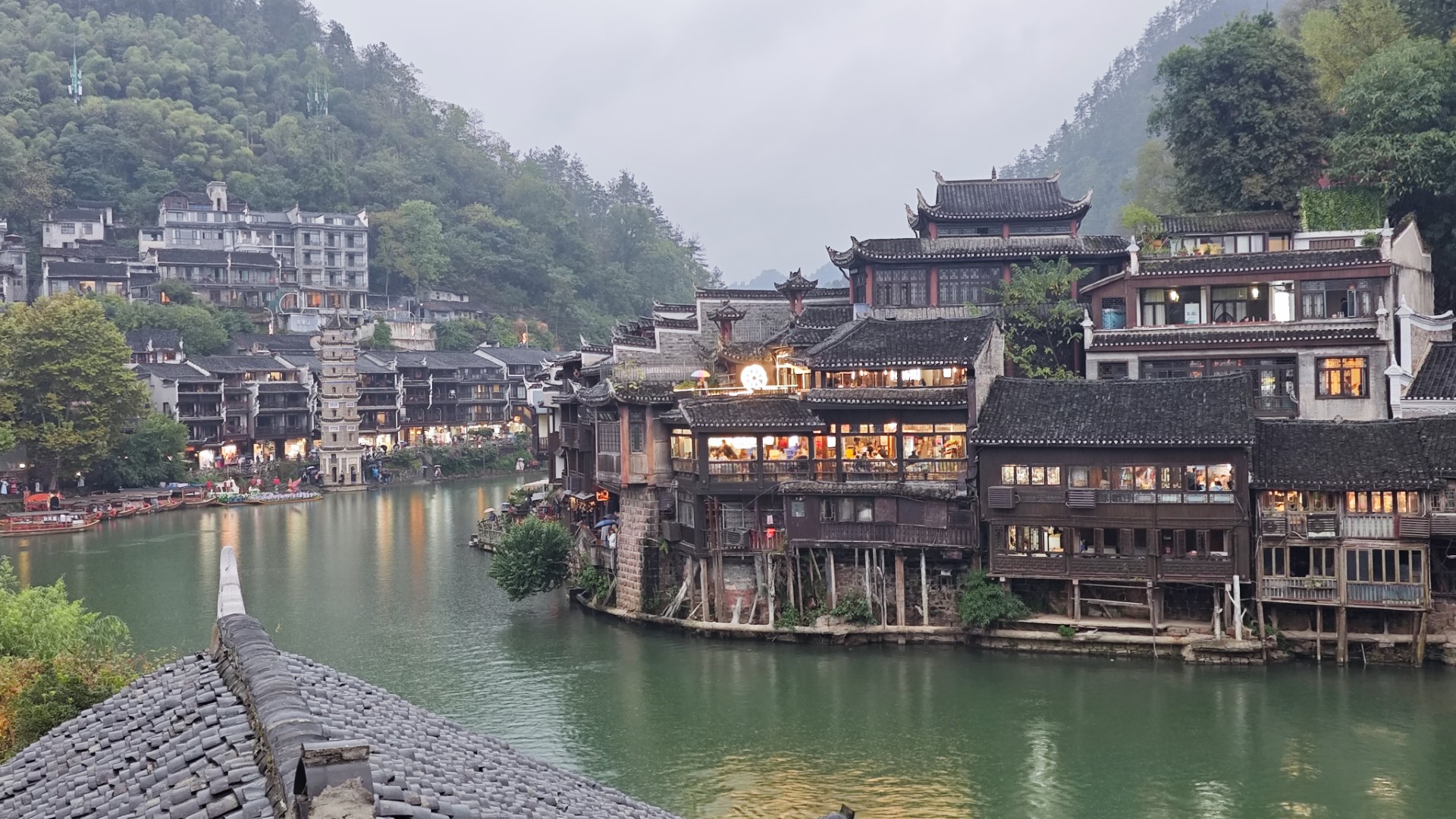 ^The stilt houses along the Tuo River in Fenghuang
Take the scheduled bus from Tongren to Fenghuang. Budget 1:30–2 hours and 30–50 RMB (3,75–6,25€), plus a local connection from the arrival point into the old town.
Spend the afternoon around the Tuo River, bridges and stilt houses, then walk again after dark.
Walking the public old-town streets is free. A Tuo River boat is a separate purchase; allow 80–150 RMB (10–18,75€) as an estimate, depending on daytime/night route and package.
Honest review, Fenghuang is beautiful, but when I went it was overly crowded and it was pouring. Not the best weather. I was a bit disappointed and found it more boring than nearby Furong, but probably just due to exhaustion and shitty weather. I couldn’t go up the hiking paths over the hills nearby. If you hike a bit, it will lengthen the visit, that may otherwise feel short. I recommend doing a full round trip around the river and some “inner” city walking by going down south west (You will notice with how busy it is that it’s the places to be), full of guildhalls, mansions and sights.
Day 16: Furongzhen
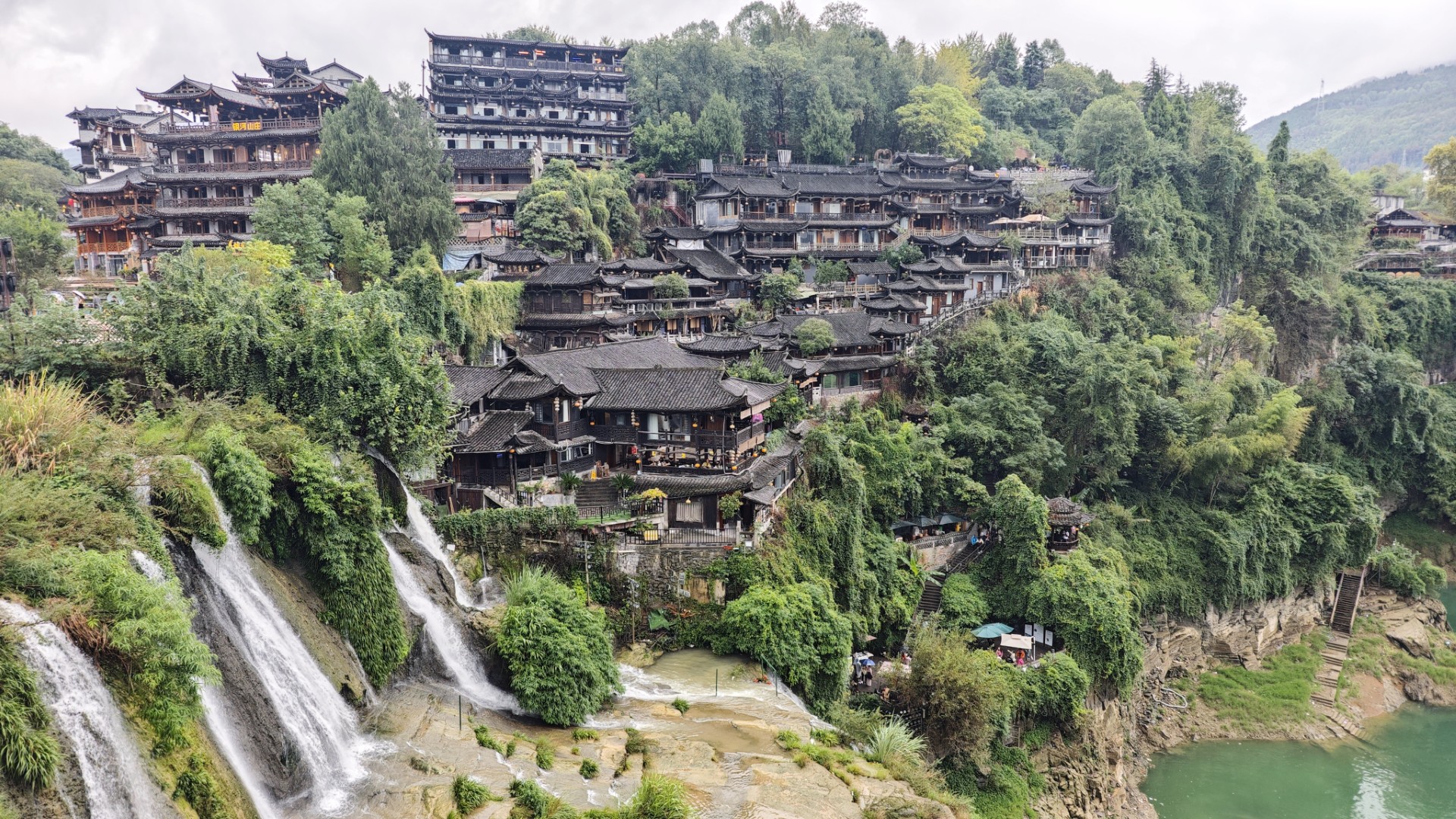 ^Furong, built above the waterfall
Reach Fenghuanggucheng station by the railway shuttle, listed at 7 RMB (0,90€), then take a train to Furongzhen in around 40–50 minutes. Allow 40–70 RMB (5–8,75€) for the train and 10–20 RMB (1,25–2,50€) for Furong’s station-to-town connection.
Stay overnight for the illuminated waterfall. The gate ticket is around 100 RMB (13€) (Yes you need to pay, but you can reenter whenever you want and have access to a lot of performances, they were boring and weird IMO, but you do you)
Start at the old town’s stone lanes, continue towards the Tuwang palace area and bridge, then follow the waterfall path for views beneath the houses. The waterfall is illuminated after dark, so you can go around twice. The full walk takes 1-1:30 hours, so a full visit day+night is only three hours, the padding comes from the performances, lasting from 30 minutes to an hour each. If you catch two, eat for lunch and dinner and visit outside the old town, you get a really busy noon + rest of the day.
I loved Furong, the waterfall is really scenic, the free parts of the town are so quiet and ancient at the same time, the weather was moody without being bad when I visited and as weird the performances were, I had a blast. I even got interviewed by a TV crew. I’m famous now.
Day 17: Tianmen Mountain and Wulingyuan
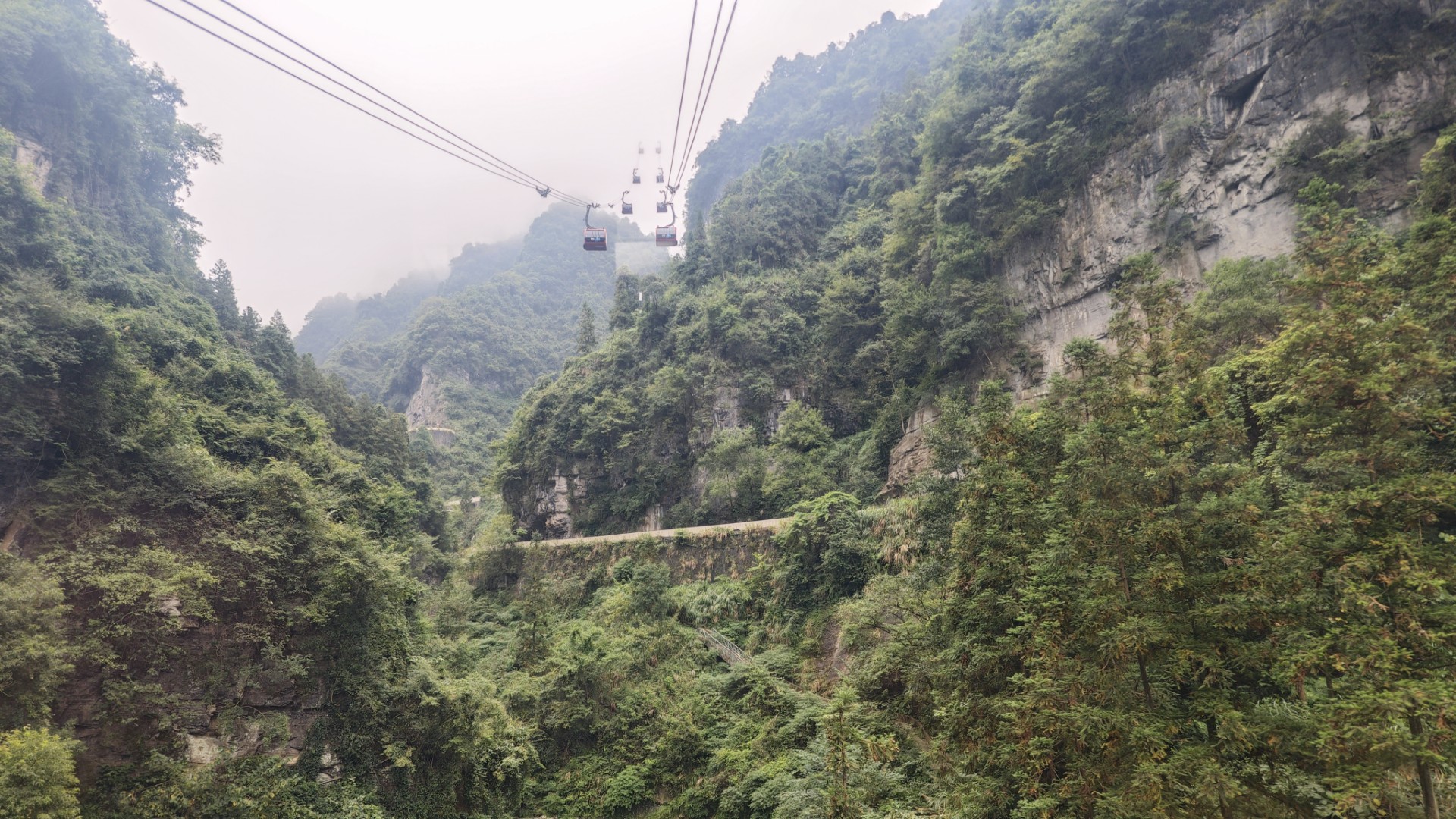 ^The cableway and winding road at Tianmen Mountain, you can see I was heading for fog
Take the train Furongzhen → Zhangjiajie West, about 25–30 minutes, costing roughly 28–40 RMB (3,50–5€). Continue by city bus towards the downtown Tianmen cableway station, allowing 30–45 minutes and 5–15 RMB (0,60–1,90€) for public transport. Luggage storage is available around the central station/cableway district, you need a ticket to use it, but it’s really cheap.
Heaven’s Gate, cliff paths and the summit
Tianmen Cave / Heaven’s Gate is the enormous natural opening through the mountain. The staircase beneath it has 999 steps and leads from the lower square to the arch. Above the cave, escalators inside the mountain connect to the summit paths, they are very slow and it feels like it’s not ending, especially when one is broken.
The summit has east and west walking circuits, combining forest with paths fixed to the cliff face, even when foggy, you can still hope to see sides of the mountains that are clear, given the way fog works. On the west side, Guigu Plank Road / Ghost Valley Walkway follows the rock walls, with a suspension bridge and views into the valleys. Tianmen Mountain Temple stands towards the southern end of the summit area. Glass sections are spread between the east, west and Coiling Dragon Cliff paths, but theuy are paid attractions, expect queues, even with a white out.
A lot of the summit areas are under construction, some parts are disappointing because of it, but it’s probably needed.
Summit map. Thanks GPT for finding that one (rare W use of AI)
Allow 5–6 hours for the cave, transport and summit walking, it’s almost a full day trip. Fog can hide the valley views and the arch, rain might be common as well. Also, it’s foggy really often, that’s mountain in a rainforest weather for you.
I got a full whiteout when I went, and on my last day, it was perfectly sunny and fine. Damn it; At least I saw the heaven’s gate from far away.
Cableways, escalators and tickets
October 2026 update: the long cableway from downtown closed for renovation on 13 October, suspending Routes A and B. Route C, using the Tianmen Cave Express Cableway in both directions, remains the operating route. No reopening date has been confirmed. When I went, it was still working, but a lot of construction was starting to happen.
The current journey is:
- Take the scenic shuttle from the downtown cableway station to the Mountain Gate.
- Ride the Express Cableway uphill, then follow the connecting path to the square beneath Heaven’s Gate.
- Climb the 999 steps, or use the lower escalator, to reach the cave.
- Take the seven-stage through-mountain escalators above the cave to the summit.
- Walk the summit circuits, then return through the escalators and Express Cableway.
Book a dated entry slot with your passport. The standard adult package costs 288 RMB (36€), including the return Express Cableway and upper escalators. The lower escalator ascent costs 32 RMB (4€) extra; glass-path shoe covers cost 5 RMB (0,60€), and the optional summit chairlift costs 25 RMB (3,10€) one way.
Before the closure, Routes A and B combined the downtown cableway, mountain-road shuttle and Express Cableway in opposite directions. The 99-bend road was part of those journeys.
Afterwards, collect your luggage and continue to Wulingyuan, roughly 1–1:30 by bus depending on pickup and traffic. Budget 15–25 RMB (1,90–3,10€). Buses leave much farther west than the cable car station, just continue that way until you find bus stops along the road. Sometimes you can find shared taxi heading that way for roughly 20RMB. Rather inexpensive.
Sleep in Wulingyuan that night, preferably within walking distance of the East Gate, for the next two mornings.
I stay in the famous backpacker hotel. YOu cannot not find it on Booking. The girl handling the hotel (with her parents, I think?) is uber fun, the ambiance is great and it’s close to all restaurants. Highly recommended. And they can book all tickets for you, without fees. Awesome.
Days 18–20: Wulingyuan
Days 18–19: Zhangjiajie
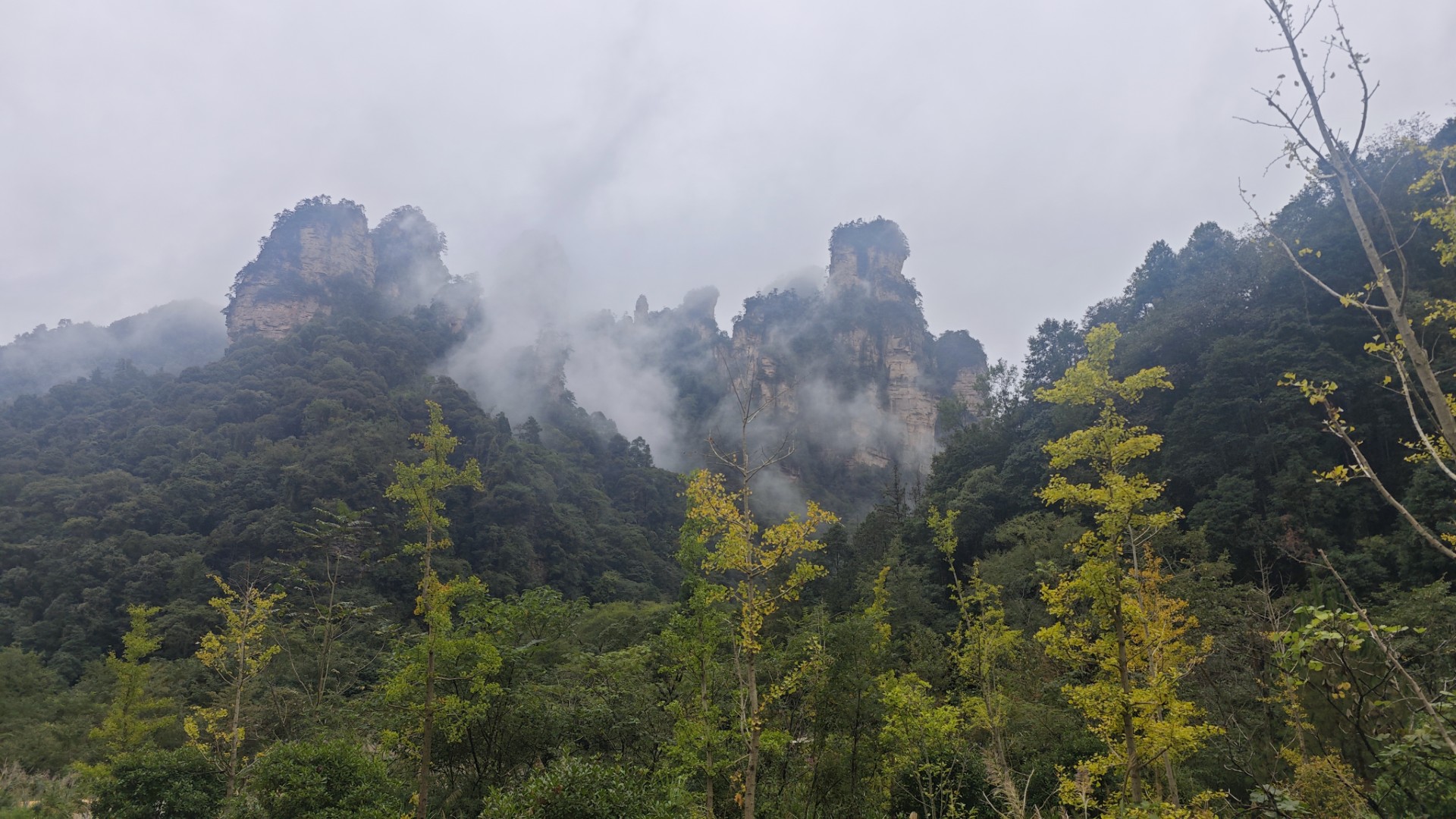 ^The sandstone pillars of Zhangjiajie in the mist
Use the first day for the upper views around Yuanjiajie and Tianzi Mountain, with buses between the high areas.
I took no cable cars. I walked several climbs of over 7 000 steps, including one towards a village on the western side of the park and another towards one of the main mountains on the eastern side. All that climbing, and I saw nothing because of the heavy fog.
Use day 19 for Golden Whip Stream and the lower valleys. Ten-Mile Gallery adds a valley path between rows of sandstone peaks. The upper circuit and valley walk can swap days to use the clearer weather for the high viewpoints. (And weather can be shitty indeed, I had fully foggy days)
The published adult entry package is 227 RMB (28,40€) including scenic buses and insurance, normally valid for four consecutive days. The elevator, cable cars and gallery train are optional extras. If you use them, allow approximately 65 RMB (8,10€) for one Bailong ascent and 72 RMB (9€) for one Tianzi descent.
Also note that the park tickets last for four days,but you have to reset/reobtain a new entrance hour each day, for that see the park’s staff. You can also do it on the same day, I did it just fine (because I didn’t know better), it seems that they have a line of foreigners stuck because of WeChat being shit. (If you successfully installed WeChat, congrats. It’s been 7 years for me of trying to make it work)
Note that you can swap any day, even with Huanglong to wait for a better weather window, which might be necessary, it can get really, really, really! foggy.
Day 20: Huanglong Cave and departure
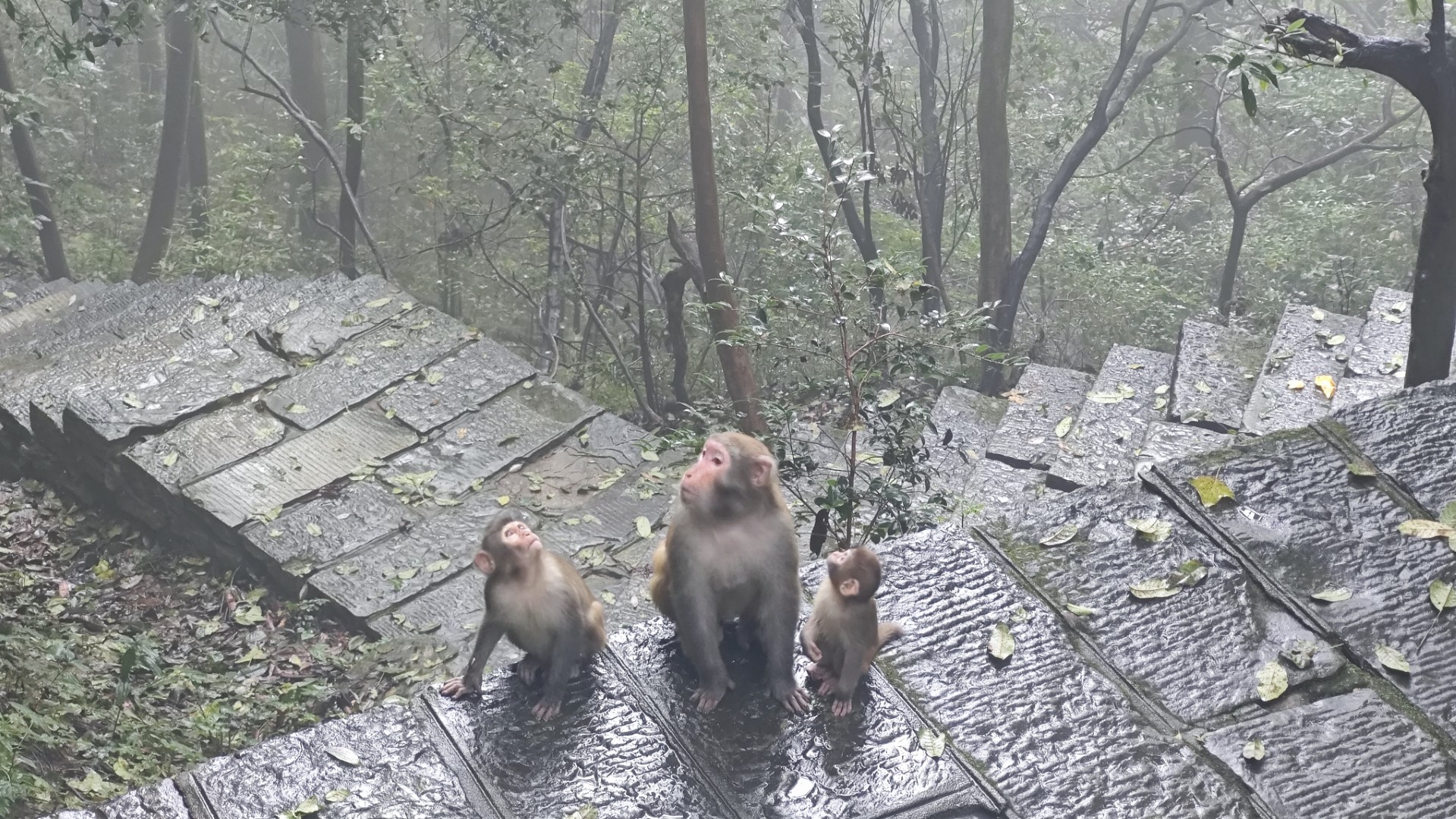 ^Monkeys along a forest trail in Zhangjiajie
Huanglong Cave / Yellow Dragon Cave is near Wulingyuan. Allow 2–3 hours inside, plus the local bus journey. Set aside 100 RMB (12,50€) for admission, and 10–20 RMB (1,25–2,50€) for local public transport.
I didn’t visit, but saw traveller pictures and had firsthand reviews, apparently it’s nice for foggy/rainy/pouring days.
For a late-afternoon departure, visit the cave in the morning and collect luggage around lunchtime. From Wulingyuan, allow 1–1:30 by road to Zhangjiajie Hehua Airport, plus the airline’s check-in margin. Wulingyuan to Zhangjiajie is cheap and quick using the public buses, then public buses also connect to the airport. If you leave the next day, use that time to actually visit Zhangjiajie and do some shopping; There are “Busy for you” shops everywhere, they sell plenty of snacks for a very cheap price.
Practical notes and total budget
Trains: use China Railway 12306 for the actual date, station and fare. Stations along the route: Xi’an North, Chengdu East, Huanglongjiuzhai, Tongren versus Tongren South, Fenghuanggucheng, Furongzhen and Zhangjiajie West. Rail budget estimates above don’t include booking-agent fees. Carry the passport used for the reservation, it’s used as a ticket. You can also book with Trip.com, but you have to pay a fee for every booking.
Sleeping: for ordinary dates, budget 150–200 RMB (18–24€) for a simple private room, or 50–100 RMB (6–12€) for a hostel bed where available. Golden Week can push them much higher, particularly around Fenghuang and Wulingyuan.
Food: allow 15–40 RMB (1,8–5€) per person per meal for simple meals with simple drinks. I ate for around 60 RMB a day (7.5€) including snacks and drinks.
The food guide breaks down the choices.
For the full 20 days in China, budget 8 000–12 000 RMB (1 000–1 500€), excluding international flights, shopping and privately guided tours. That assumes two people sharing simple rooms, public transport, the main paid sights, Emei, and the conditional panda visit.
With fewer days
For a shorter trip, remove Emei and return to Chengdu after Leshan. Removing Tongren/Fanjingshan saves another two days, with onward travel from Chongqing towards Hunan. Those were the two most skippable parts.
Xi’an was included as it was a nice entry point, but if you have only two weeks, I’d recommend leaving it out. This way, you save 6 days, putting this trip to 2 weeks!
With more days
One more day in Chengdu
Give the Panda Base its own morning, then spend the afternoon around Wuhou Shrine and Jinli or return to the teahouses. The Panda Base costs 55 RMB (6,90€), plus 30 RMB (3,75€) for its optional internal bus.
Sanxingdui: one day from Chengdu
Sanxingdui Museum, near Guanghan, displays the large bronze masks, standing figures, gold objects and ritual bronzes excavated from the ancient Shu sites.
Take a train from Chengdu East to Guanghan North, around 30 minutes, then bus 13 to the museum. Direct tourist coaches also leave from central Chengdu. Admission is 72 RMB (9€); allow 150–220 RMB (18,75–27,50€) for the outing with public transport and lunch, excluding accommodation. Reserve a dated museum ticket in advance.
Dujiangyan: one day from Chengdu
Dujiangyan combines the ancient irrigation works, river channels, suspension bridges and Erwang Temple.
Take the metro to Xipu, then a train to Lidui Park / Liduigongyuan, about 20–30 minutes for the rail leg. The scenic-area entrance is roughly 10 minutes on foot from the station. Admission is 80 RMB (10€); trains are listed from 10 RMB (1,25€) each way. Budget 130–180 RMB (16,25–22,50€) with local transport and lunch.
Dazu: one day from Chongqing
At the Dazu Rock Carvings, Baodingshan has Buddhist scenes carved along the cliffs, a reclining Buddha and the Thousand-Armed Guanyin. Beishan is a separate site with more carvings.
Take a coach to Dazu town, around 2 hours, then a local bus to Baodingshan. Allow a full day from Chongqing. Admission is 115 RMB (14,40€) for Baodingshan or 140 RMB (17,50€) for the Baodingshan–Beishan combination; budget approximately 230–350 RMB (28,75–43,75€) for a public-transport day with lunch, depending on the sites and local connections.
With one more day at Wulingyuan, spread the upper viewpoints across two days and give Golden Whip Stream a separate day. Yangjiajie adds its long sandstone walls to the pillar landscapes around Yuanjiajie and Tianzi Mountain. A third consecutive park day falls within the standard four-day entry ticket; additional cable-car rides remain separate.
Guiyang and heading to Yunnan?
If you swap things around (Chongqing - Zhangjiajie - Fenghuang - Furong - Tongren), you end up in Tongren. From Tongren you can head further, to places like Zhaoxingzhai, very postal card worthy, to Guiyang and then towards Yunnan. Or even towards Guilin in Guangxi, famous for its landscape, similar to Ninh Binh in Vietnam.


Comments?
comments powered by Disqus